What I built
I built a mobile-first usability testing platform that combines a working product concept, participant tasks, interaction events and session recording.
A product team can configure a study, share it and review how participants moved through each task without assembling a new testing setup for every concept.
Problem
Smaller product decisions often moved from internal review into delivery without being tested with users. Formal research still had its place, but the setup was too heavy for every early interaction or workflow question.
When lightweight testing did happen, task instructions, prototype links, recordings and notes were assembled for that study alone. Results were useful, but difficult to compare consistently across participants.
I wanted to make a focused test easy to run while the design was still cheap to change, without pretending it replaced deeper research.
How I built it
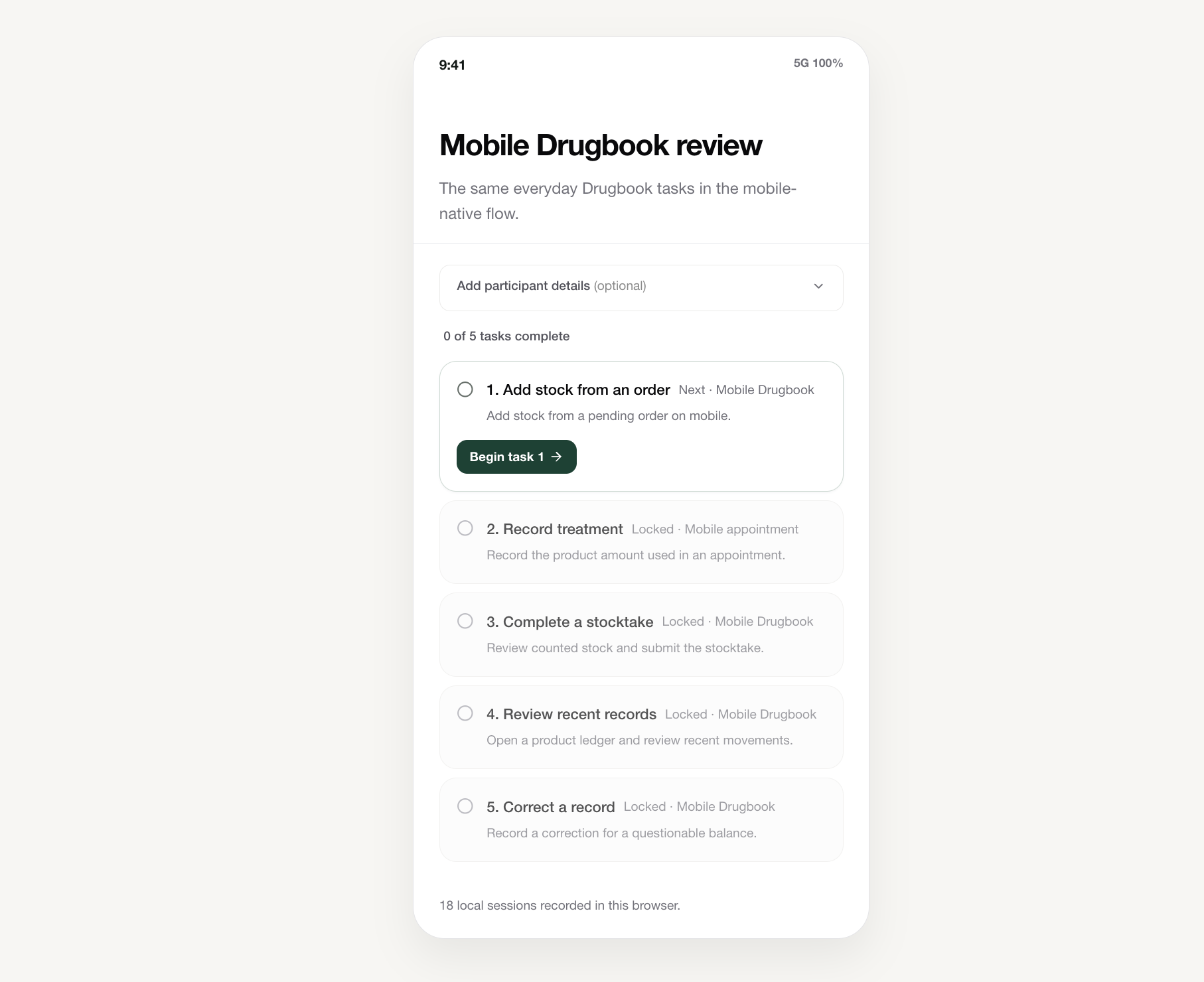
- I defined the smallest useful study: a participant receives a sequence of tasks, uses a realistic product concept and reaches a clear success or failure state for each one.
- I built the study and participant flows as a mobile web product, then concentrated on the parts that determine whether the evidence is usable: credible interactions, unambiguous task states and consistent event names.
- I added events for progress, completion, abandonment and unexpected paths. Session recording provides the context behind those events, so a team can see not only where someone stopped but what happened beforehand.
- I ran the flow end to end and revised task wording, transitions and completion rules whenever the recorded result left room for interpretation.
Value
The platform makes usability testing practical for product decisions that might otherwise be settled by internal opinion. Teams can put a realistic flow in front of participants earlier, see where it breaks and improve it before engineering commits to the wrong experience.
- Earlier evidenceProduct teams can test the riskiest part of a concept before investing in full implementation.
- Clearer decisionsTask outcomes show what happened, while session recordings explain why participants succeeded, hesitated or stopped.
- Better user experiencesConfusing interactions can be corrected before they become shipped workflows that customers have to work around.